Why Prediction Markets Will Be Bigger Than the New York Stock Exchange
What Kalshi and Polymarket got right about retail investors and what they got wrong about the general public.
Intro
I’m in my early twenties, male, work in tech, and was even on a sports team in college - that makes me one of the main target audiences of prediction markets. When I got on Robinhood (the gateway drug), it was only a matter of time before the dopamine hits of Polymarket would begin. Prediction markets have just gained popularity this year, but I think they will soon be recognized as a culturally acceptable trading platform and process volumes larger than the NYSE and Nasdaq.
Today, many people (outside of the SF-tech bubble) associate prediction markets with ill-informed speculation and horrors of late-stage capitalism terrorizing our youth’s neuron activation. However, prediction markets are just a fintech way of expressing what every statistician has believed for centuries: every event has priors and likelihood. By extension, if there is a probability that can be formulaically derived, one can easily calculate a profit or loss associated with buying that probability. For those who aren’t familiar, if you correctly predict the outcome of a soccer game by buying $10 at 50% odds, your payout would double to $20 and you’d profit $10.
 https://unsplash.com/illustrations/online-soccer-betting-with-phone-ball-coins-and-money-LjcvNp_ZF2k
Some of these probabilities cause warranted discomfort. Trading on geopolitical conflict1 has raised serious ethical issues and many users fear the surveillance infrastructure2 that has already been put in place. What’s more, I don’t buy the idea that allowing people to trade on whether there will be a ceasefire gives traders an incentive to learn more about politics. Instead, this teaches the privileged to take a seat in the audience of real conflicts that harm real people’s lives.
There are some limits to the scope of what prediction markets should trade on. The product has has grown and the virality-by-controversy phase should be over. Continuing to promote absurd trades will do more harm than benefit, and will actively mitigate their chances at becoming a mainstream trading platform. Regardless, if done right, prediction markets will unlock a new type of currency in our economy that can be most beneficial for the public.
Valuing Exchanges
| ICE (NYSE Parent) | CME Group | Nasdaq Inc. | Coinbase | Kalshi | Polymarket | |
|---|---|---|---|---|---|---|
| Market Cap / Valuation | $70.4B | $81.5B | $43.9B | $37.5B | $22.0B | $9B–15B |
Market cap/latest funding round valuations are the clearest metric to compare across public and private exchanges. CME Group is included because prediction markets are legally derivatives under the CFTC and Coinbase is included as a precedent, being the closest modern example of a new asset class going from regulatory gray zone to legitimacy in under a decade. Kalshi’s $22B is a disclosed figure from their May 2026 Series F led by Coatue; Polymarket is shown as a range because the $8B floor is confirmed by ICE’s statement3 when they invested $2B, but the $15B ceiling is an unconfirmed Bloomberg report4 of an asking price for a round that hadn’t closed at time of writing.
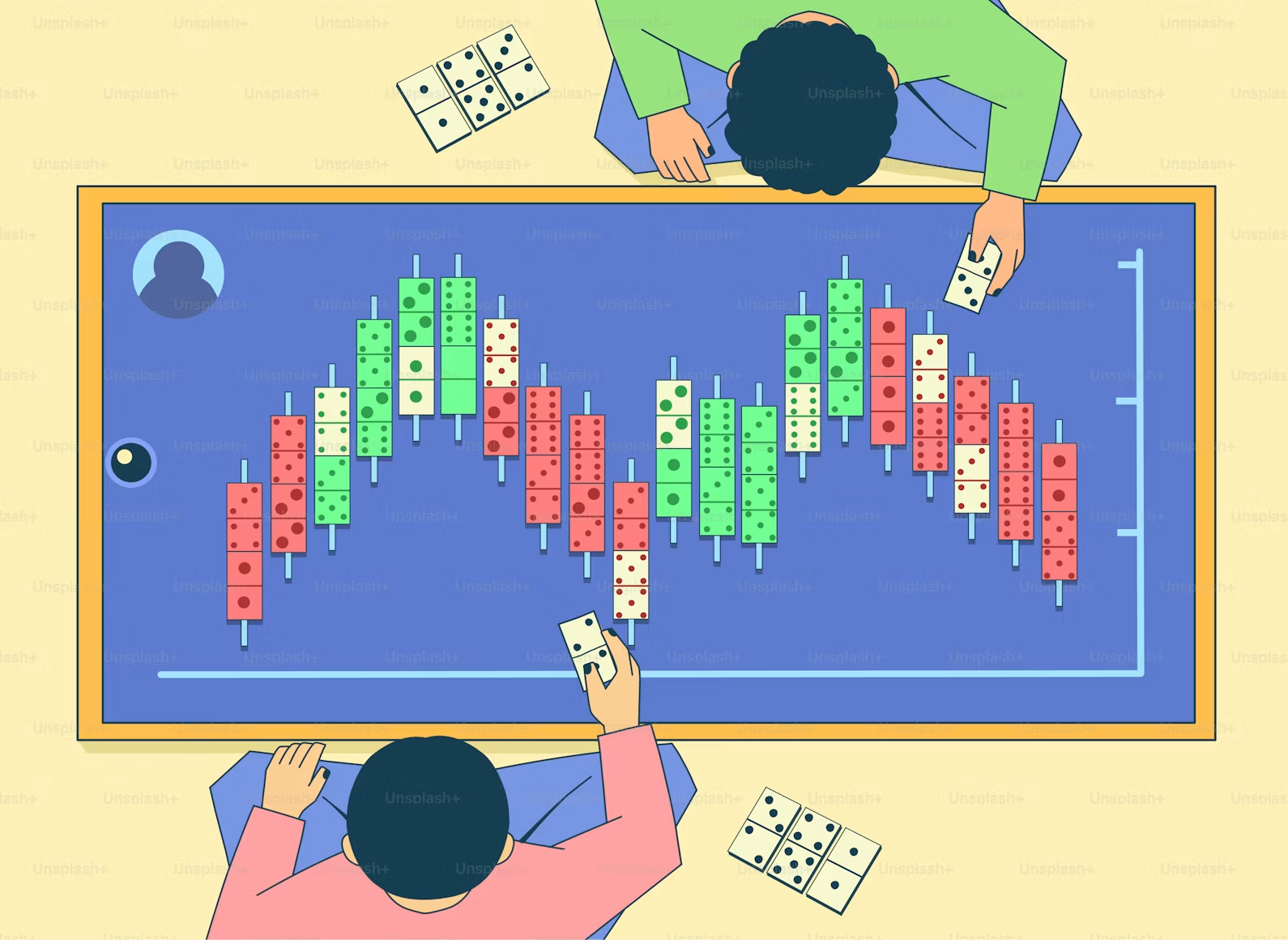
Prediction markets have grown substantially over the past year, but they still need to 4x their current valuations to catch up. Coinbase processes roughly $3-4B in daily spot trading volume. Kalshi and Polymarket combined process around $800M in reported daily volume5 as of April 2026, a figure that grew nearly 5x since last September. I expect this to grow for two main reasons.
The Media Bet
The way information is exchanged on the internet is vastly speeding up and new ways of capturing attention have proven to be effective online. Consumer tech companies now use authentic branding and content as a compelling way to distribute their software products - New Media, a movement that a16z coined.6 Traditionally, each person has two types of attention: their work and their personal life. Traditional stock exchanges get their TAM from the attention of work lives, where people follow earnings calls and business performance. Prediction markets monetize information exchanged in people’s personal lives, which doubles the TAM. Part of the New Media brand is that the line between personal and work-related content is becoming blurred. However, the growth of prediction markets doesn’t just rest on media - Kalshi and Polymarket have built infrastructure to control the information layer that unites users around certain odds around their favorite topics. There are now financial incentives to consume content and they are a part of that content. For the first time, the motivation is not centered around IPOs, it’s Love Island and the World Cup: things retailer traders care about. Owning the information layer unlocks another market of traders, that is arguably larger than the current market of stock investors.
The Retail Trend
Since the pandemic, there has been a retail trading boom and the gradual shift of fintech infrastructure and regulation to democratize access to trading.7 This was the thesis that Robinhood was founded on and the message that public venture capital (RVI, VCX, etc.) rides on.8 The actual positive effect that these platforms have had is questionable, but what has remained true is that it’s easier to put money into an asset than ever before.9
With high cost of living complaints, inflation10 hitting 4.2% this May, young citizens feel a lot of financial pressure. To even beat inflation and keep a constant balance, it’s like you need to be a full-time investor, which many people in their early career don’t have the time to do. There’s genuine demand for alternative ways to make money and retail traders are tired of making bets on stocks they feel like they can’t control. Higher access to trading is here to stay, but what will make a true difference for young Americans is closing the information gap between Wall Street analysts and retail investors. Prediction markets will likely close that gap.
Concluding Thoughts
I’m writing this a couple of days after Meta11 announced that they are also building a prediction market platform. While I think this is just another initiative to feed Meta’s data-hungry model training philosophy, it’s a sign of how important that attention layer is to enterprises.
However, there’s a key distinction in trades that people should understand before assigning value to prediction market user data. There are two different types of bets: ones where there is an underlying truth (let’s call it the bet’s Net Asset Value) and then ones where the bet pricing is a reflection of the truth (ie. the price of the bet exactly reflects the probability of the event, assuming the efficient market hypothesis). If I were betting on France to win the World Cup, I buy at odds that reflect what the public thinks, but there does exist an underlying Net Asset Value (how tired the French players are, who’s injured, etc.) that the public doesn’t necessarily know. On the contrary, the odds of betting on the outcome of the United States Presidential election are a direct real-time Net Asset Value representation - it’s a poll of the current results. If voters rationally vote the way that they bet, their data is now weaponizable and valuable to politicians, campaigns, and advertising. This generates a laundry list of implications like how politicians may act if they see their odds trailing or how they might target certain voters.
However, for prediction markets to represent elections, prediction market traders must be a representative sample of the US population, and right now the male-dominated platform definitely is not. I truly believe that hesitant consumer sentiment towards prediction markets will lighten up over the next couple of years as the products evolve to serve a more general audience. I don’t think that prediction markets will lead to egalitarian wealth distribution, but I do think that it’s correct in identifying where people want to trade, and it’s not the traditional exchanges anymore.
 https://unsplash.com/photos/a-bunch-of-flags-that-are-next-to-each-other-RPU5KFrPY90
Footnotes
-
https://www.blumenthal.senate.gov/newsroom/press/release/blumenthal-demands-answers-from-polymarket-following-suspicious-bets-on-ceasefire ↩
-
https://investors.palantir.com/news-details/2026/Polymarket-Partners-With-Palantir-and-TWG-AI-to-Build-Next-generation-Sports-Integrity-Platform/ ↩
-
https://ir.theice.com/press/news-details/2025/ICE-Announces-Strategic-Investment-in-Polymarket/default.aspx ↩
-
https://www.bloomberg.com/news/articles/2026-04-20/polymarket-in-talks-for-new-investment-at-15-billion-valuation ↩
-
https://www.pewresearch.org/short-reads/2026/05/27/trading-volume-on-prediction-markets-has-soared-in-recent-months/ ↩
-
https://www.forbes.com/sites/forbesbooksauthors/2026/06/09/prediction-markets-are-becoming-retail-tradings-next-dangerous-game/ ↩
-
https://journals.sagepub.com/doi/full/10.1177/0308518X211042378 ↩
-
https://www.fool.com/investing/2026/06/25/stock-market-worst-inflation-news-history/ ↩
-
https://www.npr.org/2026/06/24/nx-s1-5869486/meta-prediction-market-app-ai ↩