How Your Dreams Might Be Real
A theory on why quantum physics and modal realism point to your latent dreams being reflections of other worlds.
In 1869, Dmitri Mendeleev worked tirelessly over the course of a single day to organize each atomic element into a logical and comprehensible structure. Facing exhaustion, he fell asleep amid his work. Upon waking up, Mendeleev claimed to have envisioned a complete table in his dream where the elements effortlessly fell perfectly into place, finalizing his timeless invention of the periodic table.1
 https://unsplash.com/photos/a-person-standing-in-front-of-a-display-of-computer-screens-nMeIVWDiDcM
Research done in sleep labs, called polysomnography, used positron emission tomography and an electroencephalogram to conclude that humans dream every night, regardless of whether there is any recollection of it.2 Despite not remembering most of my own dreams, I like to think that I get to see what a real alternate universe looks like every night.
To some physicists, that view is correct. The Many Worlds Interpretation (MWI) was coined by American physicist Hugh Everett III in 1957.3 The theory states that there are many worlds that exist in parallel to our own based on different outcomes, like a particular electron going right instead of left. It means that our universe is constantly branching: every quantum measurement that could go more than one way goes every way, each outcome spinning off its own world. Many 20th century physicists, including Erwin Schrödinger (the man behind the infamous Schrödinger’s cat), used MWI-like theories to explain away the awkward collapsing of the wave function: instead of the cat being dead or alive, the cat is both, in its own branch of the universe. If you’re curious on how this works, you can see this in action with this quantum world splitter. The program is comedically simple, but helps convey years of complex research - quantum indeterminacy just collapses to measurement.
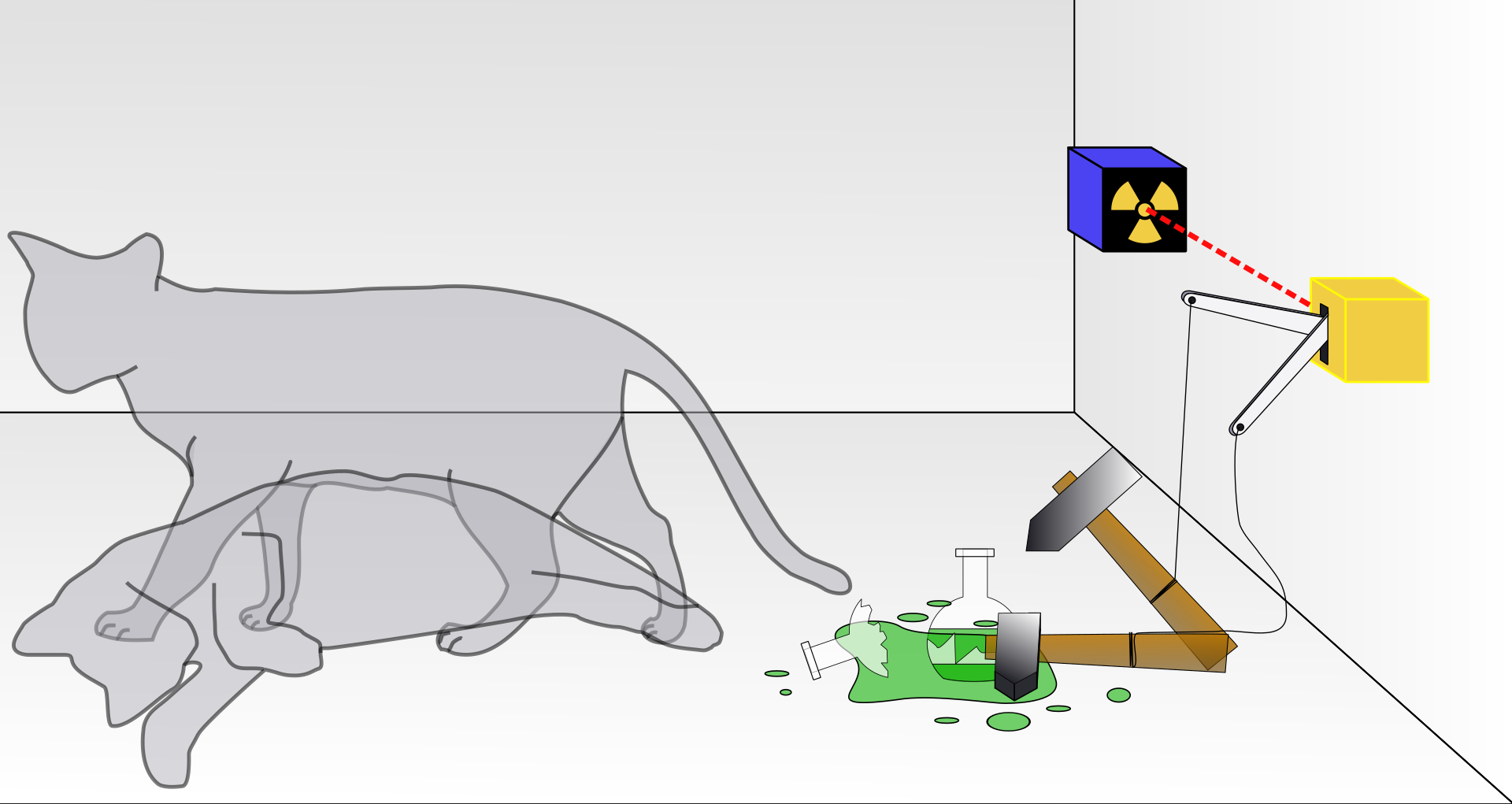 https://commons.wikimedia.org/wiki/File:Schrodingers_cat.svg
However, MWI still plays by the rules. My dreams where gravity is reversed or I’m ice skating across Rainbow Road don’t abide by the laws of physics, like gravitational constants or the speed of light. So, for dreams to be multidimensional reflections of reality, a more philosophical approach is required.
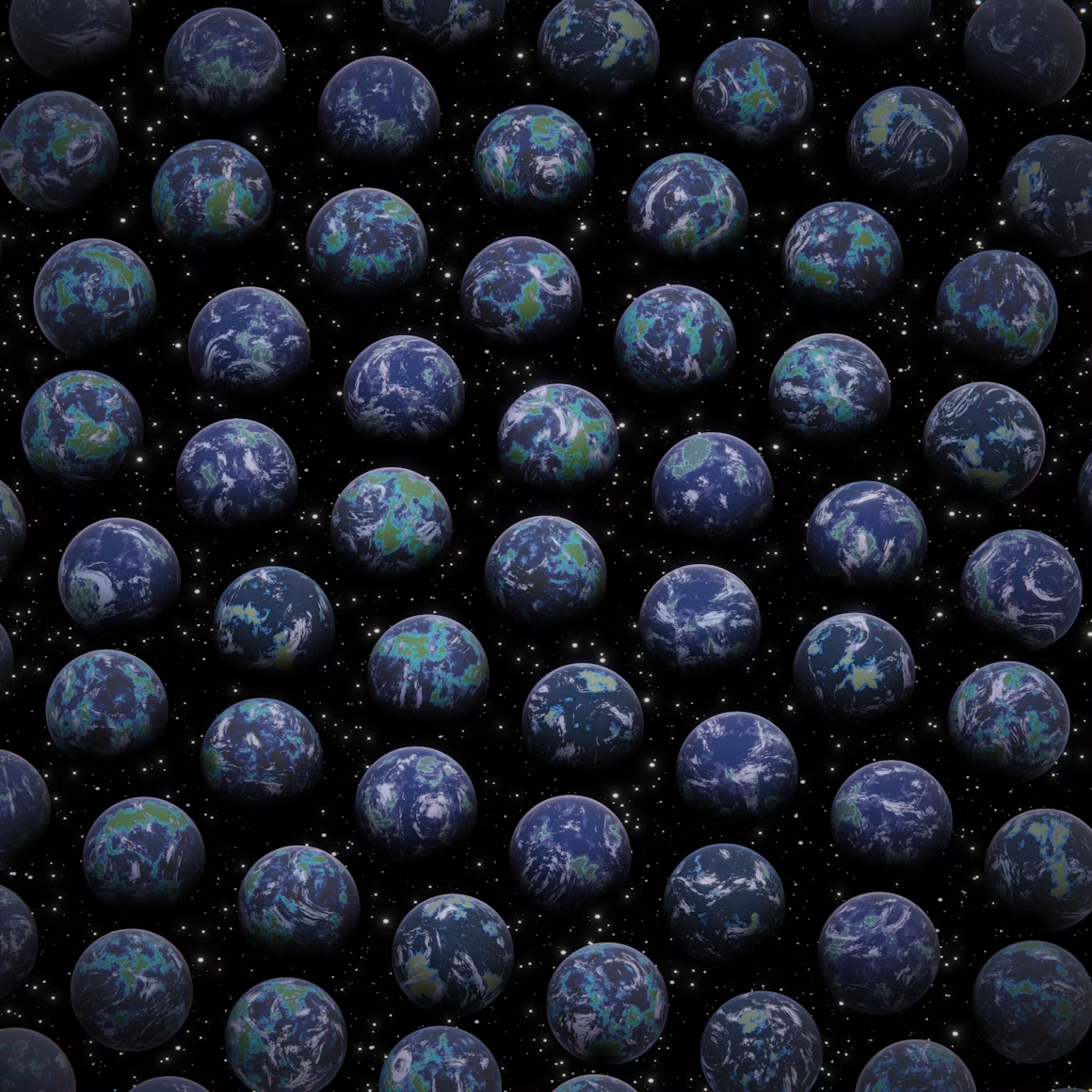
In 1986, David Lewis argued for modal realism: a view that every way a world could possibly be is a way that some world really is.4 A helpful parallel to me is that if I can physically imagine a world where proposition x is true, then a world that supports x exists.
Modal realism is an indispensability argument, meaning that without our belief in it, our best scientific theories would falter. Lewis posits that we should believe in the literal existence of concrete possible worlds because doing so provides theoretical utility across multiple domains of logical philosophy. For example, probabilistic reasoning depends on possibilities that never actually occur. When you assign a fair coin a chance of tails, that unrealized ‘tails world’ still has to count in your calculation. So a framework like Bayes’ theorem only makes sense if merely possible worlds are real enough to reason about.
 https://unsplash.com/photos/a-large-group-of-blue-balls-in-the-air-aBr2tqQ67GY
Under modal realism, the litmus test for a sound world is simple: can it be imagined without logical contradiction? Our most vivid, effortless exercises in exactly that kind of imagining, the worlds we build every night, are dreams.
Regardless of whether there is actually an observable quantum wormhole that opens every time our brains enter a sleep state, a dream is still just a reflection of a world constructed by your mind. If modal realism is correct, our dreams are glimpses into different universes. David Lewis believed this literally, as he was a supporter of versions of the multiverse theory, likely borrowing ideas from MWI. As if it’s a sign from the universe to stay in our own reality, these worlds are almost always forgotten by breakfast time.
Research on dreams is structurally difficult to conduct: there’s no observability layer since dreams can only be imperfectly described retrospectively, not via real-time examination. To my knowledge, the DreamBank dataset is the largest database of dream narratives (over 20,000), including an interesting set from blind dreamers. I scraped its data and did fine-tuning experiments and vectorized sentiment analysis on thousands of samples in search of any statistical pattern. The dataset has many dreams, but the demographic distribution is very sparse and several of the text inputs are incomplete, making it difficult to dicern concrete conclusions about the nature of dreaming.
Though dream science remains a frontier still waiting to be fully explored and the data is (currently) structurally inaccessible, dreams already offer us something remarkable: a hopeful look that other worlds exist. They tell us that there are (sometimes physically impossible) steps that can be taken to create a better world. Maybe there’s comfort in knowing that somewhere out there is a version of you that is similar enough to be recognized, yet different enough to surprise you.